
How PRO Seed’s demonstration farms are reshaping one farmer’s approach to commercial agriculture
Farmer: Rodah Justin Taban
Location: Kuanga, Maridi County, Western Equatoria State, South Sudan
Focus: Farmer training, improved planting practices and commercial maize farming
Intervention: PRO Seed Ltd. demonstration farms and maize value-chain programme
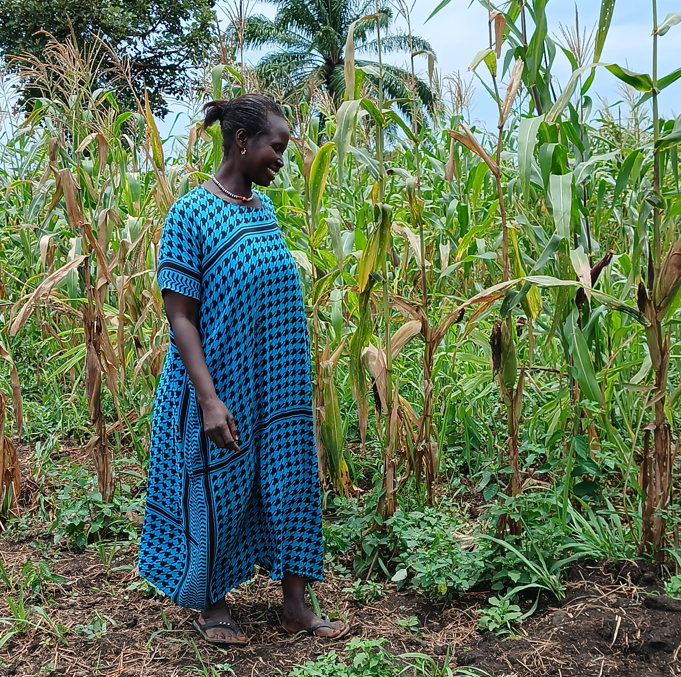
“We just planted for food, whatever little we get. There was nothing like saving or commercial farming.”
— Rodah
Her experience began to change when she started attending demonstration farm activities established by PRO Seed Ltd. in her community. Today, Rodah speaks differently about farming. She talks about improved seed varieties, better planting practices, commercial maize production and the importance of having a market for what she produces.
The change began through her participation in PRO Seed Ltd.’s demonstration farms established in her community.
Learning by seeing and doing
her community. Through these practical sessions, she learned improved ways of planting different seed varieties, including Bazooka and Macista Hybrid maize.
For her, the demonstrations provided more than information. They allowed farmers to see agricultural practices being applied in real conditions.
“I have gained knowledge on planting different variety of seeds as well as understood the importance of commercial farming.”
— Rodah
The knowledge did not remain at the demonstration site.
Rodah’s son observed what was being done at the demonstration farms and decided to apply what he had seen by planting maize behind their home.
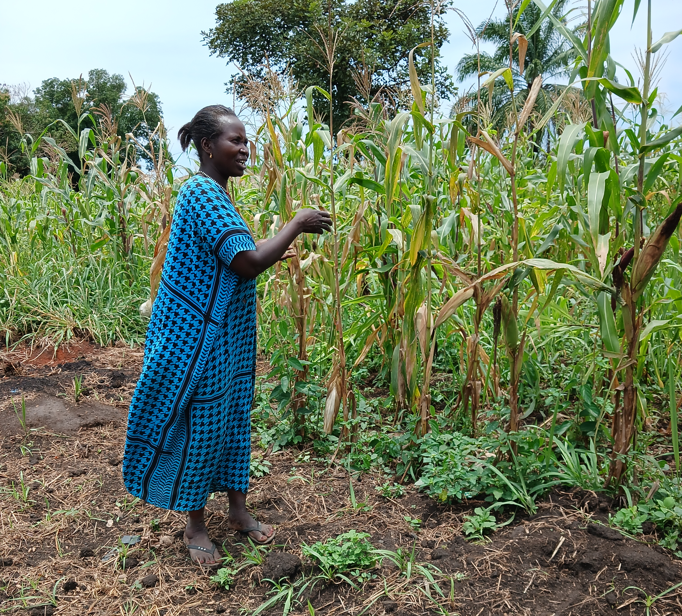
“He just saw what we were doing at the demo sites and he decided to plant here at the back of the house. Now see how they have grown. At least they will eat these ones now.”
— Rodah
For Rodah, this became an example of how agricultural knowledge can move from a demonstration plot into everyday household practice.
She also applied what she learned to okra production. Her household consumed some of the crop, she kept some for the market and saved some seed for planting when the rains return.
A season tested by poor rainfall
Rodah’s journey, however, has not taken place under ideal conditions.
Rainfall has been a major challenge in Maridi during the season. She says the lack of consistent rain has affected food production and made it difficult for her household to produce enough food.
“If there was consistent rain, I could have planted more food crops around the homestead while I focus on the maize farming that PRO Seed will buy.”
— Rodah
She also says some farmers were hesitant to participate in the programme because of concerns about the rains.
The experience illustrates an important reality for farmers: training and market opportunities can open new possibilities, but agricultural production remains highly dependent on seasonal conditions.
From Subsistence to Commercial Ambition
The experience has also influenced how Rodah views the potential of farming as a source of income. Despite the difficult season, Rodah is already thinking about her next planting cycle differently.
With PRO Seed Ltd.’s maize value-chain programme, she plans to change her farming methods and cultivate at least two feddans in the next planting season. A key factor in this ambition is the prospect of having a buyer for the maize she produces through the programme.
“I will change my farming methods and be able to cultivate at least two feddan because I know that your company will buy my maize once they grow.”
— Rodah
For Rodah, access to a market address one of the concerns that can discourage farmers from increasing production: uncertainty about what will happen to the crop after harvest.
Her words capture the significance of that concern:
“I don’t have the fear of my maize getting rotten because they stayed too long because there is no market.”
— Rodah
The opportunity she describes is therefore not simply about producing more maize. It is about connecting production to a market.
Taking agriculture beyond one generation
Despite the challenges, Rodah sees agriculture as an opportunity that can benefit households and younger generations. Her vision extends beyond her own farm.
She encourages parents to give children small spaces around the homestead where they can cultivate crops under guidance.
For young people in Maridi, her message is equally direct. She points to the availability of farmland and opportunities to access mechanisation and markets, encouraging young people to consider agriculture as an avenue for building their livelihoods and contributing to their communities.
“Grab this opportunity and develop your county together.”
— Rodah
A farmer’s definition of food
Rodah’s understanding of agriculture comes back to something much more fundamental: food.
Asked what PRO Seed’s tagline, “If you ate today, thank a farmer,” means to her, she gives a simple answer:
“It means appreciate the person whose work resulted in my satisfaction and that of my family.”
Her own experience puts that message into context. The maize grown by her son can feed the household. The okra she planted has already contributed to their food supply. The knowledge gained from demonstration farms has changed how she thinks about seed, production and commercial farming.
And looking ahead, she sees an opportunity to take the next step: produce more, farm differently and connect what she grows to a market.
From demonstration to opportunity
Rodah’s story illustrates a pathway that PRO Seed Ltd. seeks to build through its farmer engagement:
Demonstration → Knowledge → Application → Household production → Commercial ambition → Market opportunity
Her experience does not yet represent a completed commercial farming success story. Her planned expansion to two feddans and future maize sales are still ahead. What can be documented today is the change in her knowledge, application of new practices and intention to move towards commercial production.
That distinction matters. Sustainable agricultural impact is not created by a single training session or a single harvest. It develops when farmers can learn, apply, adapt and access opportunities that allow them to produce and sell.
For Rodah, the journey has already begun.
PRO Seed Ltd. — Growing opportunities, feeding the nation.
“If you ate today, thank a farmer”
__________________________________________________________________________________
Rodah Justin Taban is a farmer from Kuanga, Maridi County. Her experience was documented through an interview conducted as part of PRO Seed Ltd.’s maize value-chain activities in September 2026.