In Madebe Payam, Acting Paramount Chief Prince Jimmy sees PRO Seed’s maize value chain programme as a path to income, dignity and peace.
By Alan Clement, Communications Officer, PRO Seed Ltd. | Madebe Payam, Ibba County·
Prince Jimmy, Chief of Madebe Payam, Ibba County | Photo credit Alan
Prince Jimmy speaks with the calm authority of a man who has weighed a decision and found it good. At the time of the interview, Jimmy who was also serving as Acting Paramount Chief of Ibba County, has watched outsiders come and go with promises. PRO Seed’s maize value chain programme, he says, is different — and the difference shows in his people’s gardens.
For Prince Jimmy, the growing interest in maize cultivation represents more than an agricultural shift. It offers an opportunity for households to put their land to productive use, earn an income and reduce their dependence on external assistance.
As farmers take up the opportunity to cultivate more maize under PRO Seed Ltd.’s maize value chain initiative, Jimmy says he is encouraged by what he sees in his community. Households that previously planted relatively small quantities are increasingly focusing on maize production, motivated by the prospect of selling their harvest and earning an income.
“Before, they just used to plant few quantities of maize. But now, they are focusing on it because they know that they will generate income,” he said in an interview in September 2026.
That income is the engine of everything the Chief hopes for. Where households once planted small patches for the table, they now expand their plots because a buyer is waiting. PRO Seed supplies the seed; farmers plant on their own land; the company buys the harvest.
A leader who prizes work over waiting
For Chief Jimmy, the initiative as an opportunity to encourage greater economic participation among his people, particularly at a time when many households have limited resources to invest in farming.
“I don’t want them to be lazy, to just sit and wait for NGOs to come and support them. I want them to work with their own hands so that they can generate income,” he said.
The arrangement, as Jimmy understands it, gives farmers access to seeds and a potential market for their produce, while allowing the cost of the supplied seeds to be deducted from the proceeds of their grain sales. Farmers cultivate their own gardens rather than relying on land allocated by the chief, giving them an opportunity to expand production on land they already own or use.
For households that have land but cannot afford sufficient seed to cultivate it, this arrangement could help address one of the barriers to increasing production. Jimmy recalled discussing the proposal with his sub-chiefs and boma chiefs before endorsing it, explaining that he wanted community members to understand both the opportunity and the terms involved.
One farmer, he said, had enough land but was cultivating only a small portion because he lacked the resources to buy more seed. The prospect of receiving seed and settling its cost after harvesting appealed to community members who saw it as a practical way to increase their production.
“They deduct their money later. This is not for free. This is my own, but I don’t have it now,” Jimmy recalled one farmer explaining, likening the arrangement to borrowing seed and repaying its cost from the harvest.
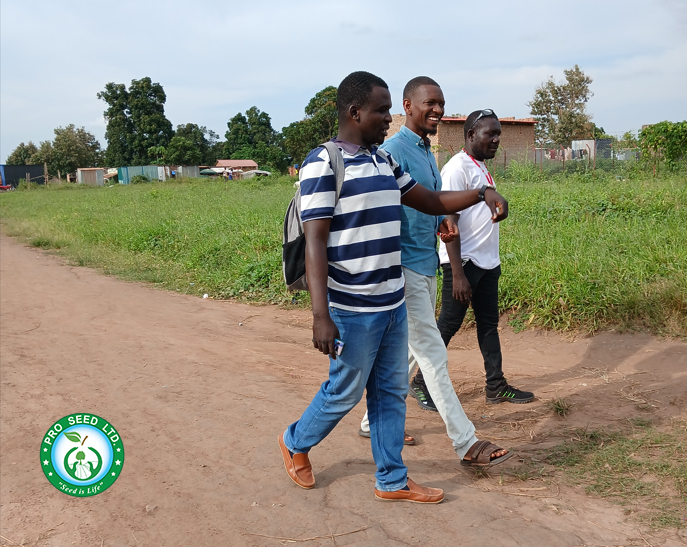
Prince Jimmy heading to attend a local inter-Payams peace soccer match | Photo credit Alan
Trust will depend on delivery
While Jimmy is supportive of the initiative, he is not unaware of the reservations surrounding agricultural projects that promise farmers inputs and markets. His account suggests that community confidence will depend less on the promises made at the beginning and more on what happens when the maize is ready for sale.
He recalled previous experiences in which organisations distributed seeds, encouraged farmers to plant and subsequently left communities with poor harvests or produce they struggled to sell. Referring to one such experience in the Sakure area, he said farmers had reportedly filled their stores with maize without anyone coming forward to purchase it.
That history has left some people in Madebe cautious about whether PRO Seed will fulfil its commitment to buy their grain, even as they proceed with cultivation.
“Up to now, many of the people are seeing it like you guys are just joking,” he said. “They are doing their part. They want to prove you guys are serious or not.”
For Jimmy, this scepticism is understandable. Farmers are committing their time and labour to production, and the promise of a market is central to their decision to participate. If the company does not purchase the harvest as expected, the consequences could extend beyond an individual season, potentially weakening confidence in similar initiatives in the future.
He believes, however, that the company’s presence on the ground offers some reassurance. He singled out the work of the production officer, whom he regularly sees visiting farms and following up with participating farmers, as an indication that the initiative is being monitored.
“When you give someone a project, you need to follow up. You have to make sure that people are doing what you came for,” he said, adding that supervision allows problems to be identified and addressed before they undermine production.
His support, therefore, comes with an expectation: PRO Seed must deliver on its market commitment.
“If you guys are serious from your side, and you do what you have told them you are going to do for them, you will see the improvement by the next year.”
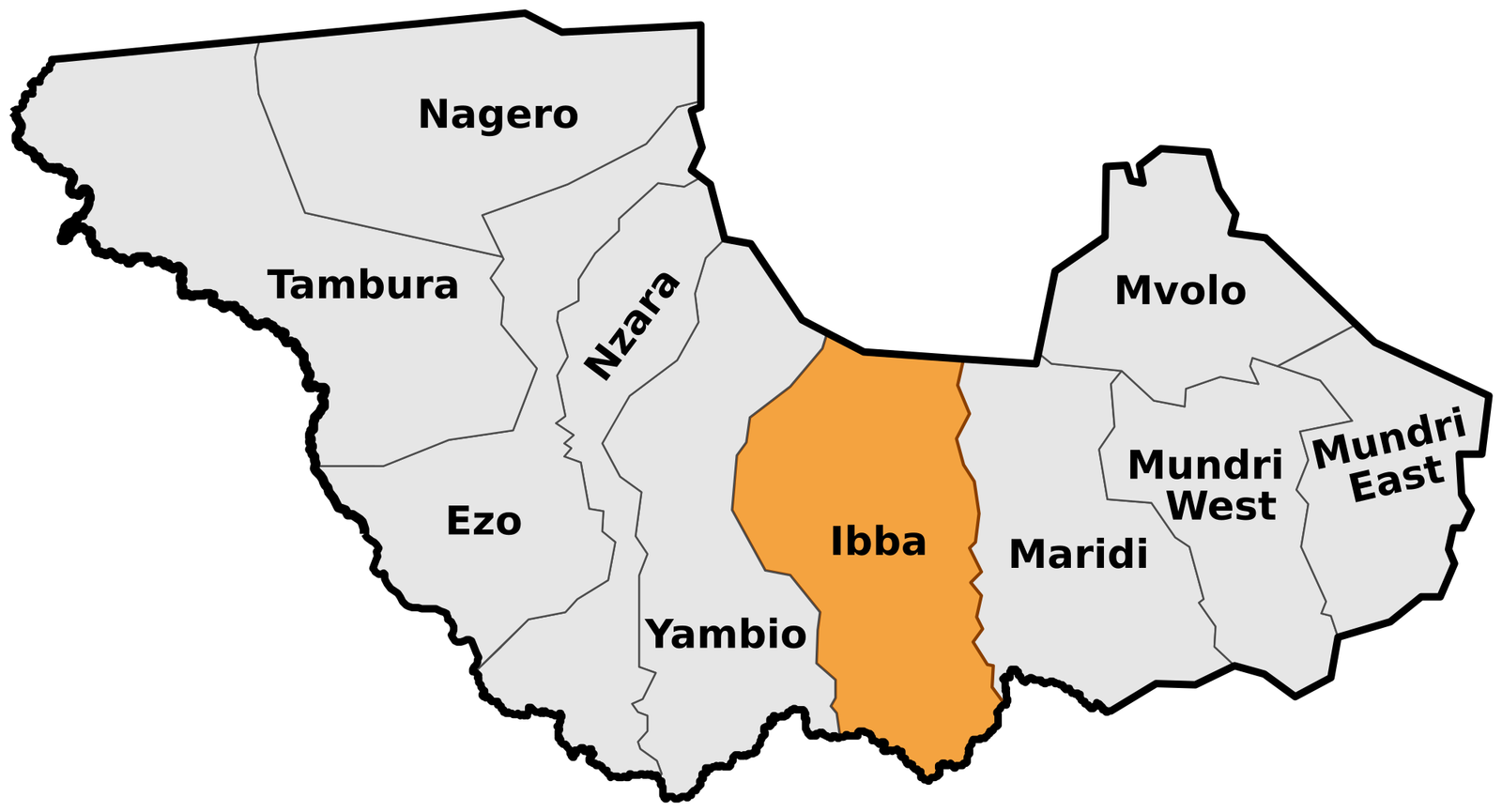
Map of Western Equatoria State showing Ibba County (highlighted)| Courtesy photo
A bigger ambition for local food production
Beyond the immediate prospects for participating households, Jimmy hopes increased maize production will contribute to a stronger local food supply and reduce the need to bring food products into South Sudan from elsewhere. Although maize has not traditionally been a major part of the diet in his community throughout the year, he believes increased production could make it more readily available, complementing crops such as cassava.
“The issue of bringing food from outside the country is not good. Yet we have fertile land. We can produce maize, flour in our own home.”
His ambitions extend to local processing, which he believes could create additional value for the community while making commercial sense for the company. Rather than transporting grain elsewhere for milling and then bringing flour back, he suggested that PRO Seed consider bringing its milling machinery closer to production areas.
Jimmy also hopes the programme will expand its reach in the coming planting seasons, allowing more farmers across Ibba County, particularly in Madebe, to benefit. He wants those currently cultivating one feddan to increase their acreage to two or three as their resources and experience grow.
Such expansion, in his view, could improve household food availability while creating opportunities for families to earn money from surplus production. He believes the money households save by producing some of their own food could be redirected towards other priorities, including school fees and small businesses.
Changing perceptions of farming
For Jimmy, the case for agriculture is not limited to the commercial opportunities offered by a particular programme. It is also about challenging attitudes that regard farming as an inferior occupation, despite the central role farmers play in feeding households and supplying markets.
He argued that people who dismiss farming often overlook the source of the food they purchase every day, urging community leaders and other citizens to recognise agriculture as an important foundation for household welfare and economic development.
“The person who will say that farming is a dirty job, I can say, I am sorry for you. Because you don’t know where the money comes from,” he said. “Every day you want to eat. So, where is this food coming from? It’s coming from farmers.”
He encouraged fellow chiefs to promote farming within their communities, pointing to the availability of fertile land and the potential for households to meet some of their own food needs rather than spending limited income on everything they consume.
His argument is rooted in the realities of household finances: even where farming does not make a family wealthy, producing food for domestic consumption can free up money for education and other essential needs.
“We don’t have that resource that can be distributed for us every month. We don’t want to stay and wait for NGOs to come and support us. We need to work with our own hands.”
Jimmy says he has not asked PRO Seed for payment or personal benefits in exchange for supporting the initiative, explaining that his decision was based on what he believed it could offer the community. He directed the company to engage the Payam administration as part of the local coordination process.
Ultimately, however, the initiative’s credibility in Madebe will be tested at harvest time. Farmers have begun investing their labour in the expectation that the company will provide the market it has promised. Whether that commitment is honoured will influence not only their willingness to expand production but also the confidence of other households considering participation.
For Jimmy, the opportunity is clear, but its promise must be matched by action. If farmers can produce more, sell their grain and earn from their work, he believes the benefits could extend well beyond a single harvest — strengthening household resilience and encouraging a more self-reliant approach to agriculture.
Farming without fertiliser — by design
The Chief was firm on one condition before the programme began: no fertilizer on his land. “I told him, don’t ever distribute fertiliser to my community. I have fertile land.” He is pleased the instruction has been honoured — and notes that it aligns with both law and expertise.
The use of fertilizer, he observes, is restricted in parts of Equatoria, from Western Equatoria to areas such as Kajokeji, Lainya and Kaya in Central Equatoria, while the plateau around Magwi, Pajok and Obbo supports the farming.
From food security to national security
Ask the Chief what locally grown, locally milled maize would mean, and the conversation turns quickly from the dinner table to the safety of the county. “Leave alone food security — even national security,” he says. Idle land becomes bush, and bush, in his telling, becomes a hiding place.
Farms also put eyes along the roads. “If my people start planting all this road from here up to Suwe, up to Yambio, I’ve covered a lot of place,” he says. “If there is something going on, if I see newcomers, they will come and report to me directly.”
The harvest is also changing the local diet. Maize was once a seasonal food here, with cassava the staple. “We don’t used to eat maize before — only in the rain season,” he says. “But now we are producing more, so the food will be enough for my community.”
“Whenever you have bush, that means you have rebels. Now I’m reducing the level of bushes.”
The Chief’s ambition runs past the current harvest. PRO Seed’s programme will reach 500 farmers a season in Ibba, renewing each year through 2028. He wants more. “I wish by next year the farmers will register more than 500, to cover all the county, and especially my space in Madebe,” he says. “If now you plant one feddan, by next year you go to two, three — so that indirectly we are supporting our country.”
His boldest hope is a mill in Madebe. “I wish you can bring the machines and start producing maize from my area — imagine you receive our flour, made from Madebe.” He makes a businessman’s case for it too: milling locally would spare PRO Seed the cost of hauling grain out and flour back. “Bring your machine down here, so you do only one transport — to the market.”