
By Alan Clement
Communications Officer, PRO Seed Ltd.
Feature Friday | The People Behind PRO Seed
Growth is often measured in visible milestones: new projects, expanding operations, larger teams and new business opportunities. But behind every change in a company is another kind of work, less visible but equally important; the work of keeping its finances, records and administrative systems in order.
At PRO Seed Ltd., a company steadily broadening its footprint in South Sudan’s agricultural sector, the company’s growth brings increasing demands on the people and systems responsible for ensuring that resources are accounted for, transactions are documented and administrative processes keep pace with operations. As activities expand across different locations and business areas, accuracy and coordination become central to keeping the company running effectively.
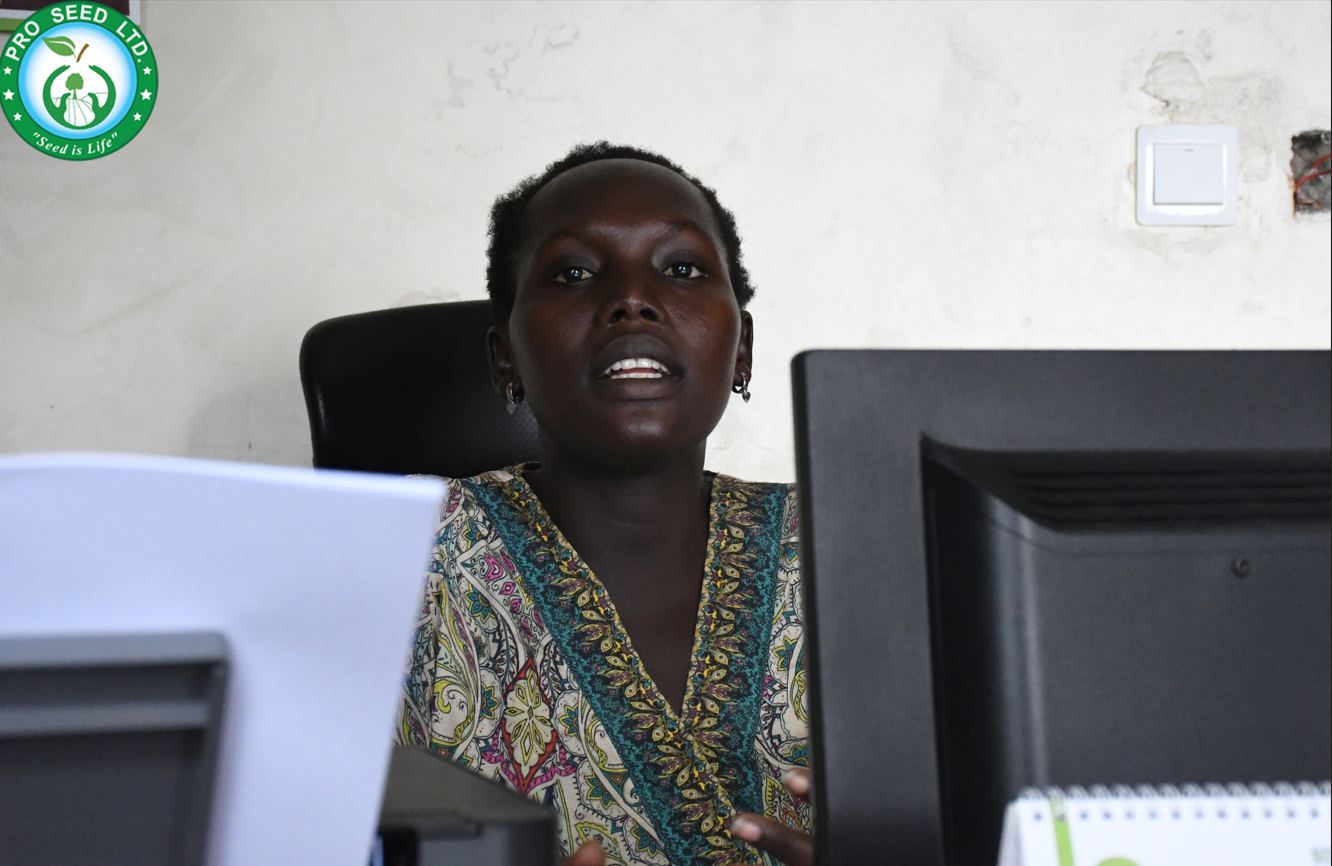
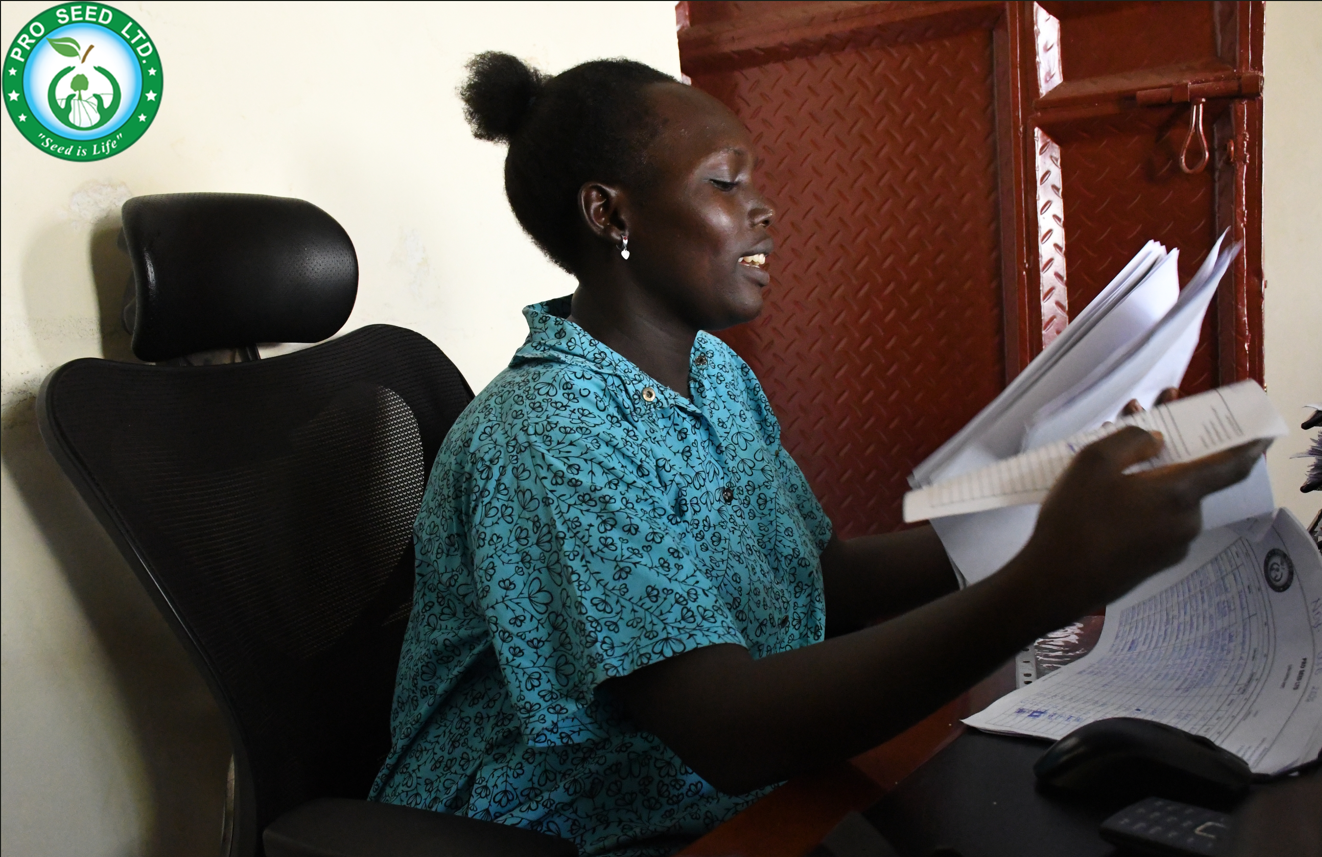
That function runs through Kiden Sarah, Finance and Admin Assistant at PRO Seed’s Juba offices. Her work is the paperwork most of the company never sees: processing invoices, reconciling what was delivered against what was paid, and maintaining the records on which the company’s accounts, its procurement decisions and its obligations to farmers all depend.
From handling financial documentation to supporting administrative processes, her role sits within the operational framework that connects the company’s daily activities with its wider business objectives.
Diversification is where systems of that kind are usually tested. A seed business can run on seasonal cycles. A milling operation buys grain continuously, holds stock, and pays suppliers on tighter terms — so a single late payment or an unrecorded delivery becomes a problem that compounds into the next season. Kiden Sarah has a view of that risk that few others in the company do.
For this week’s Feature Friday, we asked her what the transition looks like from the finance desk.
Beyond farming and milling
Ask Kiden Sarah what it takes to produce a bag of maize flour and she does not begin with the mill. She begins with the money: the budget that has to be in place before the first lorry moves, the records that have to be right before the first farmer is paid, and the coordination that holds the two together.
“Producing a bag of maize flour takes more than just farming and milling. It requires proper planning, coordination, financial control and financial management at every stage.” _Sarah
What has particularly impressed her is the coordination developing between staff, farmers and the transportation arrangements needed to move maize from production areas to the milling facility. She sees these connections as essential to making the process more manageable once the maize is available.
“What surprised me most about the whole process is the coordination. The transportation is in place. The process becomes much easier because of the coordination between staff and farmers and the relationship we are building with them,” she explains.
For Sarah, the growing administrative records also tell a wider story about the company’s changing identity. They reflect a company moving beyond seed production, increasing its supplier base and taking on additional responsibilities as it ventures further into value addition.
“The records show us that PRO Seed is really growing beyond just seed production into value addition. We are expanding our operations, increasing our suppliers and taking on more responsibilities. Through this, we are contributing to food security,” she says.
As PRO Seed prepares to purchase maize from farmers for processing, the relationship between procurement and finance will become increasingly important. Farmers will expect timely payment for their produce, while the milling operation will depend on a reliable supply of maize to support production.
For Sarah, meeting these expectations will require more than having money available. It will depend on proper budgeting, accurate documentation and effective cash flow management, supported by close cooperation between the finance and procurement functions.
“To ensure that farmers are paid on time, we need proper budgeting, accurate documentation and good cash flow management,” she says.
If we have these things in place, it will help ensure that farmers receive their payments on time. _Sarah
Her response points to an important operational requirement as the company moves towards commercial processing: financial and procurement teams must work together to ensure that the purchase of agricultural produce is properly documented and payments are managed efficiently.
Asked how she would strengthen that coordination, Sarah emphasises one principle: “teamwork”.
The same discipline, she argues, will be necessary as PRO Seed develops DegidNa Maize Flour and Tamam Animal Feeds alongside each other. Bringing two product lines to market requires financial and administrative systems capable of supporting their respective needs while maintaining accountability across the business.
“First, we need proper budgeting, clear financial records and accountability. We also need effective procurement and good teamwork. If finance cooperates properly with procurement, it will help us manage these products successfully,” she explains.
Managing growth behind the scenes
Expansion brings opportunities, but it also increases the administrative workload. As PRO Seed takes on more activities and responsibilities, Sarah says the growing volume of financial records and the need to meet deadlines have become some of the most challenging aspects of her work.
The challenge is not simply recording more transactions. It is ensuring that documentation remains accurate, complete and available when needed, even as operational demands increase.
“The biggest challenge I have faced is that, as we expand our operations and responsibilities, we also have more financial records to manage”.
You find yourself handling many records while also having to meet deadlines, and that can be challenging. _ Sarah
She explains that coordination with the procurement team has helped her manage the increased workload and ensure that the necessary information and documentation are in place.
Despite the demands, the experience has allowed her to translate academic knowledge into practical professional skills. Financial documents that she previously studied in theory—including purchase orders and payment vouchers—have become part of her everyday responsibilities.
“When I was at school, we studied these things theoretically. But when I came to PRO Seed, I found that I was putting everything I had learnt into practice. We work with financial documents, purchase orders, payment vouchers and follow-ups. These are things you do practically, and they gradually become part of you,” she says.
For someone who enjoys working with numbers, this practical experience has reinforced her sense of belonging in the profession.
“I feel that I am in the right place because I like working with numbers. Almost everything I do involves working with numbers,” she adds.
From the farmer to the final product
For Sarah, PRO Seed’s messages, “Growing Opportunities, Feeding the Nation” and “If you ate today, thank a farmer”, are more than corporate expressions. They describe a relationship between farmers, agricultural production and the food that eventually reaches consumers.
She sees the farmer as the starting point of the entire process. Without farmers producing maize, there would be no grain for the company to purchase, no flour to process and no finished product to take to the market.
“When we say, ‘If you ate today, thank a farmer,’ it takes me back to the beginning of the process. If there is no farmer, we will not get the maize. The farmers plant and produce it, then provide it to us. PRO Seed mills the maize, and after processing, we have the final product that goes to the market,” she explains.
She also connects the company’s ambition of growing opportunities to the employment and income prospects that could emerge from expanding agricultural production and processing.
South Sudan has a large youth population, many of whom face limited employment opportunities. Sarah believes that the development of the milling operation could create jobs while providing farmers, particularly young people, with an opportunity to earn from agricultural production.
“If PRO Seed opens the milling operation, I believe many people will get employment opportunities. We are also giving farmers an opportunity to produce and sell their maize to us. In that way, we are creating opportunities for young people in South Sudan,” she says.
A different perspective on agriculture
Perhaps the most personal part of Sarah’s reflections is how her own perception of agriculture has changed. She admits that, while growing up, she viewed farming negatively, associating it mainly with hard physical labour rather than recognising its wider economic and social value.
Her experience has since challenged that perception. Working within an agricultural company has helped her appreciate the connection between farming, food production and the everyday survival of communities.
“While growing up, I had a negative perception of agriculture. I thought it required a lot of energy and hard work. But I came to realise that agriculture is different. If there is no agriculture, we will not survive because everything we consume comes from agriculture,” she says.
Her message to young South Sudanese is not to dismiss agriculture or regard it as an unattractive career. Instead, she encourages them to recognise the opportunities that exist across the sector and the contribution they can make through production.
“My advice to young people is not to undermine agriculture. If you involve yourself in producing something like maize, you are helping many people. Many people will benefit from your produce, and you will have helped save lives.” _Sarah
As PRO Seed prepares to move further into maize processing and product development, Sarah’s reflections offer a reminder that the success of an expanding agricultural business depends on more than machinery, production capacity and market demand. It also depends on the financial discipline, administrative systems and teamwork that connect each stage of the value chain.
For the people working behind the scenes, keeping the figures straight is part of making that growth possible.