
By Alan Clement
Communications Officer, PRO Seed Ltd.
Feature Friday | The People Behind PRO Seed
A company is built not only in its fields, offices or production facilities, but also through the people who make its daily operations possible. Behind every hectare planted, tonne harvested, bag sold and product processed is a person whose commitment, judgement and willingness to learn contribute to the organisation’s ability to deliver.
As PRO Seed Ltd. continues to expand beyond its traditional seed operations into commercial grain production, milling and animal feeds, its workforce is becoming increasingly diverse. Agronomists, field officers, machine operators, drivers, accountants, storekeepers, sales personnel, technicians and other professionals now contribute to different stages of the agricultural value chain, bringing distinct skills and responsibilities to a common purpose.
At the centre of this growing workforce is Grace Albida, Human Resource & Administration Manager at PRO Seed Ltd., whose role extends beyond recruitment to include employee development, workplace culture and helping the organisation build a workforce capable of growing with the business.
Her work sits at the point where the company’s ambitions meet the realities of the labour market it recruits from; a market where formal employment is scarce, where experience in commercial agriculture is still being built, and where a single job often carries an entire household.
Because growth is not only a question of capacity and capital. It is a question of whether the people inside the company understand what they are part of, whether they are treated in a way that makes them want to stay, and whether the culture that got PRO Seed this far can survive the company doubling in size.
And there is an inherent balancing act.
Young people need a chance and the patience that comes with it. The business needs standards, discipline and delivery. Different departments need to feel like one company. And every employee needs to leave work with something more than a salary; a skill, a sense of progress, and their dignity intact.
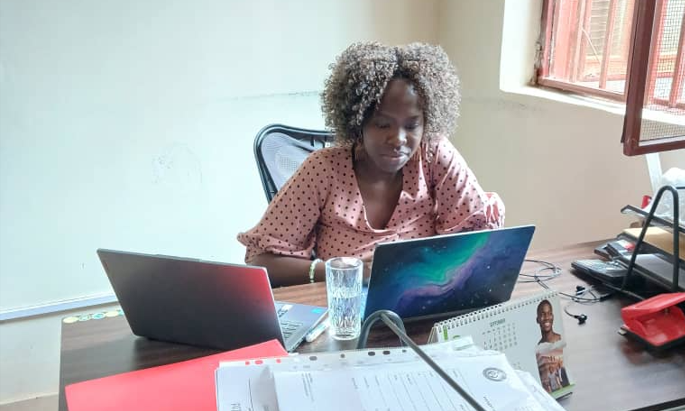
Grace Albida at her desk | Photo credit Alan
Beyond the Certificate: What a Growing Company Actually Needs
Qualifications tell an employer what a candidate has studied. They say very little about whether that person will thrive in a season that runs on weather, distance and long days. For Grace Albida, the difference between the two is something she has watched play out many times.
“Agriculture is still a foreign subject for most South Sudanese. A growing company like PRO Seed needs open-minded people — those with the willingness to learn about it, and to understand its importance for our country.”
– Grace
That willingness, she argues, matters more than a farming background. Grace does not believe that a person must necessarily be an agriculturist to contribute meaningfully to the sector. In her view, people from different professional backgrounds can find a place in agriculture when they recognise its role in improving livelihoods and providing one of society’s most fundamental needs: food.
“The people who thrive in agriculture don’t have to be agriculturists themselves. What matters most is the interest and the willingness to understand why agriculture is important for each and every one of us.”
– Grace
One Company, Many Kinds of Work
The challenge of a diversifying business is that its people rarely share a desk, let alone a job description. A farmer in Gumbo, a machine operator in Nesitu and an accountant in Juba can easily feel they work for different companies. For Grace, holding them together is deliberate work.
“It comes down to making sure diverse voices are heard, and that respect is maintained across the board. When employees from different departments feel respected and heard, they perform even more — and that lifts the whole company.”
– Grace
Inclusion, in her telling, is not a slogan but a way of drawing in South Sudan’s many communities. For a company operating across communities with different backgrounds and experiences, Grace also considers diversity and social inclusion important in ensuring that a wider range of voices contributes to the company.
Bringing more tribes and backgrounds on board, she says, ensures “more voices are put on the table, and every voice has the opportunity to be heard.”
Dignity, Opportunity and Professional Growth
For Grace Albida, dignity at work is reflected not only in how employees are treated internally, but also in how they conduct themselves when representing the company. She emphasises the importance of employees carrying out their responsibilities diligently and ensuring that their conduct reflects positively on PRO Seed.
This principle also extends to the company’s engagement with young people and communities, where employment and agricultural opportunities can provide individuals with tangible ways of contributing to society.
The same philosophy informs the company’s approach to entry-level recruitment. While experience remains valuable, Grace says PRO Seed Ltd. also seeks to provide opportunities to graduates and young professionals beginning their careers, allowing them to acquire practical knowledge while working alongside more experienced colleagues.
“We try and support them by, of course, engaging them in trainings here and there, but we also improve their knowledge on some of the things related to their careers,”
– Grace
She describes the interaction between experienced employees and newcomers as a two-way learning process in which younger staff can develop their skills while benefiting from the experience of senior colleagues.
Lessons from a Difficult Labour Market
Managing a diverse workforce in South Sudan also comes with challenges, particularly in a labour market where employees bring different backgrounds, experiences and approaches to work. For Grace, one of the most important lessons has been the need to understand people as individuals rather than applying a single approach to every situation.
Work ethic, and how people respond to pressure, she says, are shaped by histories that reach well beyond the office. She says differences in upbringing, previous employment experiences and circumstances outside the workplace can influence how people respond to responsibilities and challenges.
“I’ve learned to be more patient, and to treat every person differently. Understanding an individual based on their particular experiences has really helped me a lot in how to navigate the challenges.”
– Grace
Changing the Perception of Agriculture
Another challenge facing the sector is the perception among some young South Sudanese that agriculture is primarily a physically demanding or “dirty” occupation, rather than a broad industry that encompasses production, science, technology, logistics, business, processing and marketing.
Grace believes that some of these perceptions arise because people have not had the opportunity to see the agricultural value chain beyond farming itself. She encourages young people to remain open-minded and, where possible, visit agricultural operations to understand the range of activities involved.
“Most of the time you find that this is just an individual perspective on something, but they have not yet really seen the whole agricultural work,”
– Grace, encouraging those interested to experience agricultural activities firsthand.
Protecting a Culture of Belonging
As PRO Seed continues to grow, Grace believes that one aspect of the company’s culture should remain central: a sense of belonging.
She argues that employees should feel that, despite the different responsibilities they carry, they are part of a wider organisational family where they can receive support and continue developing professionally.
“It’s very important for us… to feel like this is a place where they can, despite their work duties and what they have to contribute to the development of the company, feel like a second home for each and every employee.”
– Grace
Recognising the People Behind the Food
For Grace, PRO Seed’s message, “If you ate today, thank a farmer,” is ultimately a reminder to recognize the people whose labour makes food available, even though their contribution can easily go unnoticed by consumers.
“The people behind the hard work, the labourers in the farms, the farmers themselves, they’re not really recognized when it matters most,” she says, urging people to appreciate the work that goes into producing and securing the food that reaches consumers.
Her understanding of PRO Seed’s broader ambition, “Growing opportunities, feeding the nation,” similarly extends beyond the company itself. She sees increased demand, milling and expansion along the maize value chain as opportunities to encourage greater agricultural production, create employment and demonstrate the potential of agriculture to contribute to South Sudan’s economic development.

Checking off her phone as she settles in for another day of management | Alan
Ultimately, Grace Albida’s work is not simply about filling positions; it is about helping PRO Seed build a workforce that can adapt to the company’s growth while maintaining the values that hold its diverse operations together. In her approach, qualifications provide an important foundation, but curiosity, adaptability, respect, commitment and the willingness to learn are equally important qualities for people seeking to build careers in South Sudan’s evolving agricultural sector.
At PRO Seed Ltd., the future of agriculture is not built by certificates alone; it is built by people who are willing to learn, contribute and grow with the sector.
– Grace