By Alan Clement
Communications Officer, PRO Seed Ltd.
Feature Friday | The People Behind PRO Seed
A strategy is written in an office in Juba. A harvest happens somewhere else entirely — in a field, in the heat, with a farmer who has already decided what he thinks about advice from town.
Agriculture is usually explained through decisions. A variety is selected, a season is planned, a target is set. But none of that becomes food until someone stands in a field at [planting time] and shows a farmer exactly how deep to place the seed, how far apart, and why the spacing he has used for years is quietly costing him a third of his yield.
As PRO Seed Ltd expands across the maize value chain — from certified hybrid seed into Hagana Maize Flour and Tamam Animal Feeds — every part of that chain depends on one thing happening first: grain has to come out of the ground, in the quantity and quality the rest of the business was built to handle. The mill at Nesitu cannot process a plan. The feed line cannot run on intent.
Standing at that point, where the company’s plans meet actual soil, is Yongo Emmanuel, Production Officer for Juba.
His work is not conducted from behind a desk. It is conducted in the field, alongside farmers who are being asked to change how they have farmed for most of their lives — to plant in rows, to weed on time, to trust a seed that costs money over one saved from last season’s crop. He is the person who has to make that argument in person, and then be there when it is tested.
Because adoption is not a communications problem. It is a trust problem. A farmer who follows advice and fails does not simply lose a season; he loses his willingness to try again, and often the confidence of everyone who watched. The margin for being wrong in front of a farmer is very small.
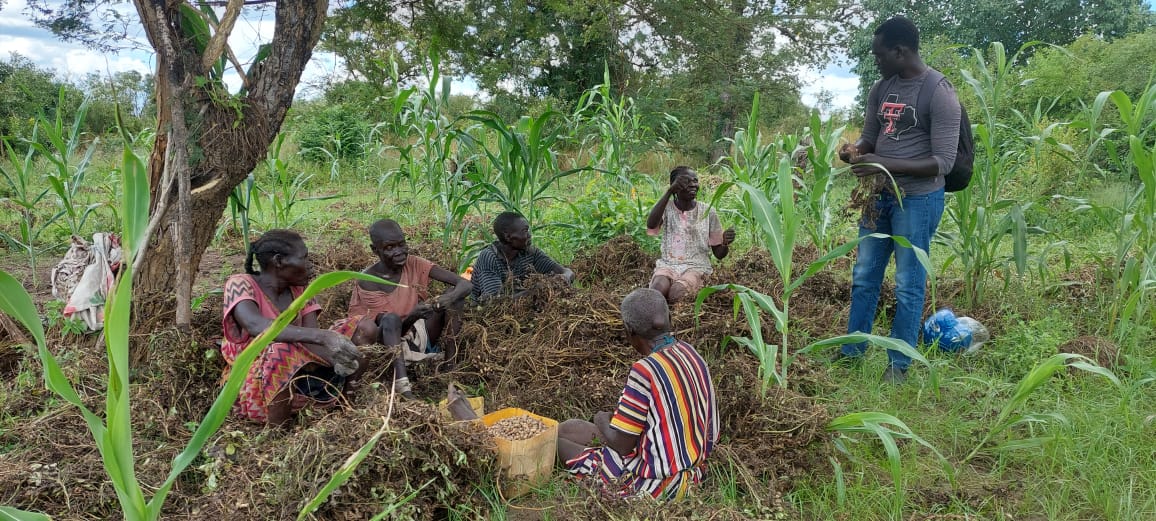
Emmanuel having a light moment with farmers in Ngangala following a harvest of Groundnuts
Where the Work Actually Happens
Field work does not look like the version of agriculture that appears in reports. For Yongo Emmanuel, a field day is rarely just a visit to a farm.
It begins with a plan: what needs to be seen, which farmers need to be visited, what problems may have emerged and what can be done about them. Sometimes, the work means inspecting an established field. At other times, it means sitting with farmers, listening to what they are experiencing and working with them to find practical solutions.
It is in this space between the field and the farmer that Emmanuel sees the real work of agricultural development.
| “With farmers, it’s not a one-way thing that they are supposed to learn from you. You will also learn from them.” — Yongo Emmanuel |
Beyond putting seed in the ground
Agriculture can appear simple from a distance: prepare the land, plant, wait and harvest. On the ground, Emmanuel knows it is far more demanding. He knows that most yields in South Sudan are lost long before harvest, and not to dramatic causes. It is lost in small decisions taken casually.
Emmanuel identified several practices that farmers sometimes underestimate — from selecting quality seed and planting at the right time to maintaining proper spacing, controlling weeds early and monitoring fields regularly. Each decision, he said, can ultimately influence the productivity and income a farmer gets from a season.
For Emmanuel, the lesson is straightforward: a good harvest is not the result of one decision. It is the outcome of a chain of decisions made throughout the production cycle.
Quality seed provides an important foundation, but it cannot carry the entire season on its own. Farmers must select varieties suited to their local conditions, prepare their land properly, plant on time, manage weeds and pests, and harvest and handle their crops appropriately.
For Emmanuel, agronomic support therefore goes beyond telling farmers what to plant. It is about helping them understand why each decision matters.
| “Most farmers really don’t put these things as serious. At the end of the day, it will affect the yields they get.” — Yongo Emmanuel |
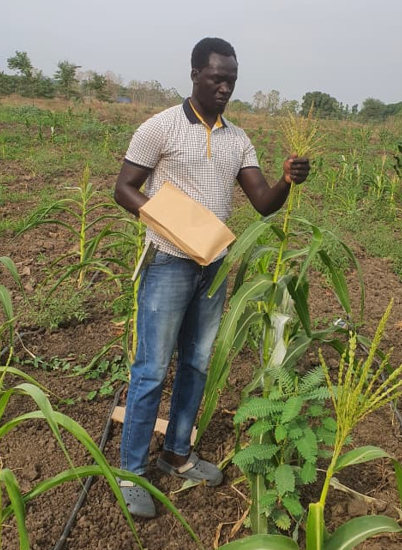
Emmanuel bagging Maize tassel at Gumbo maintenance site.
What the Farmer Knows That the Officer Does Not: Learning from the people who know the land
Extension work carries a quiet assumption: that expertise travels in one direction, from the trained officer to the untrained farmer. Emmanuel rejects it flatly. One of the less visible parts of his work is also one of the most important: listening.
Farmers possess knowledge that cannot simply be picked up from a classroom or technical manual. They understand their local agroecological environments — when rains usually come, when drought becomes a risk and which pests commonly affect their crops.
Emmanuel sees this local knowledge as part of the information needed to solve problems effectively. The relationship, therefore, is not simply technical staff teaching farmers. It is a two-way exchange in which professional knowledge meets years of experience accumulated in the field.
| “With farmers, it’s not one-way learning. We learn from them too—they know their land, their climate and the challenges they face.” — Yongo Emmanuel |
There is real professional discipline in that position. The farmer holds decades of local observation that no training course contains — which rains fail, which pest arrives in which month, which corner of a field has never performed. Emmanuel holds the agronomy. Neither is sufficient on its own, and the second only becomes useful once the first has been listened to.
From Food to Business
PRO Seed’s ambition, repeated across every venture in the company, is that farming in South Sudan should be understood as a business rather than a means of survival. Emmanuel is one of the people who has to make that abstraction real, one farmer at a time — and in his account the shift is not agricultural at all.
| “The major difference is the mindset of the farmers and the way they make decisions.” — Yongo Emmanuel |
The business-minded farmer thinks beyond consumption. The farmer considers input costs, expected yields, market demand, timing, quality, profitability, record keeping, risk and the possibility of reinvesting in the next production cycle.
The company’s contribution to that change comes in three parts: access to quality seed, agronomic advice, and linkages to opportunities across the value chain. But the outcome he is working toward is narrower and harder than any of them. It is a change in how a farmer understands a cost.
“The goal is to help farmers see improved seed and good agronomic practices not simply as expenses, but as investment.”
| “Not simply as expenses, but as investment.” — Yongo Emmanuel |
The harvest that means more than food
For someone working closely with farmers, success is not measured only in tonnes or acreage.
For Emmanuel, some of the most rewarding moments come when a farmer achieves something they once believed was beyond their reach.
It could be a healthy crop after overcoming production challenges. It could be a farmer achieving a good harvest for the first time. Or it could be the knowledge that improved production has helped a family pay school fees or build a better home.
These moments give agricultural extension work a meaning that extends beyond the farm gate.
| “For me, the most rewarding moment… is when seeing a farmer achieve something they initially thought that it might not be possible.” — Yongo Emmanuel |
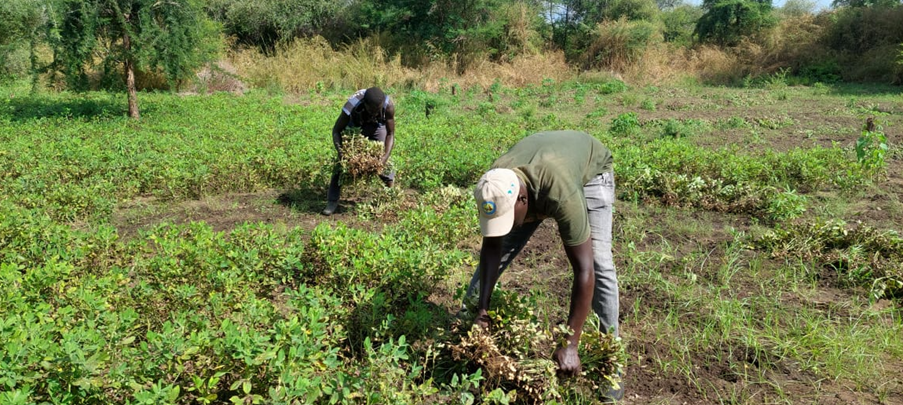
Emmanuel in Lirya helping farmer Zachariah harvest his Groundnuts (Serenut2 variety)
The Argument He Has to Win With Young People
South Sudan’s agricultural potential is not in dispute. Whether young South Sudanese want any part of it is a different question, and Emmanuel is direct about the obstacle in his way.
Emmanuel believes South Sudan’s young people need to see agriculture differently.
Too often, farming is viewed as an activity for older generations or as an occupation with limited prospects. Yet, in his view, the country’s agricultural potential creates an opportunity to position farming as both a business and a career.
That requires more than access to land.
Young farmers need exposure to improved production technologies, agribusiness skills, financial literacy, marketing opportunities, mechanization and digital tools. Practical field demonstrations can also help make agriculture more tangible and attractive to a generation looking for meaningful economic opportunities.
Most importantly, young farmers need to understand the full value chain. Production is only the beginning. Aggregation, processing, marketing and value addition can create additional opportunities — including employment for others.
| “If a farmer understands the full value chain — from production to aggregation, processing, marketing and value addition — they can begin to see agriculture as a business that can create employment, rather than simply a means of surviving.” — Yongo Emmanuel |
The first harvest as a beginning
Perhaps the clearest expression of Emmanuel’s philosophy comes when he talks about a young farmer completing a first successful production cycle.
With the right seed, appropriate agronomic knowledge, practical support and the determination to apply what has been learned, a first harvest can become the foundation for something much larger.
A farmer who begins with one acre may decide to expand. Increased production can create income, encourage reinvestment and, eventually, create work for others.
The harvest therefore becomes more than food or income. It becomes evidence that agriculture can work — and that agriculture can have a future.
| “That moment represents possibility and hope.” — Yongo Emmanuel |