
By Alan Clement
Communications Officer, PRO Seed Ltd.
Feature Friday | The People Behind PRO Seed
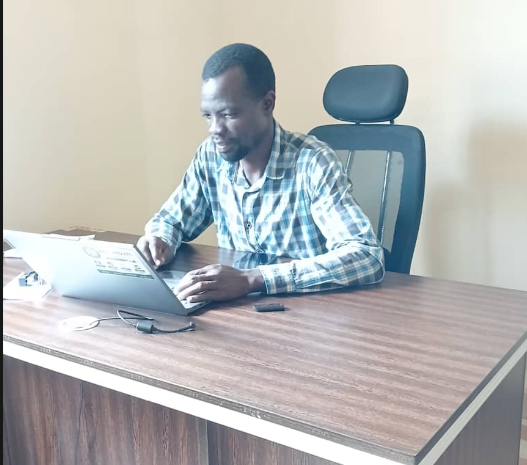
Agriculture begins in the field, but the business of agriculture does not end there.
A successful harvest still has to find a market. Grain has to move. Products have to be processed. Farmers have to earn. Consumers have to buy. And somewhere between production and the final sale, a business has to make enough financial sense to keep going.
That is the challenge facing agribusinesses in South Sudan — and the space in which Inyani Geoffrey, General Business Manager at PRO Seed Ltd., operates.
As PRO Seed expands from hybrid seed into a broader agricultural value chain — including grain markets, milling and the development of Hagana Maize Flour and Tamam Animal Feeds — the question is no longer simply how much can be produced. It is how to build a commercially viable system around that production.
For Inyani, that means looking beyond the immediate harvest and asking bigger business questions: Where is the opportunity? Where is the risk? What creates lasting value? And what does it take to build an agricultural enterprise that can survive beyond a single season?
A reliable sector in an unpredictable economy
Ask Inyani why agriculture is worth the effort, and he starts not with idealism but with economics.
“In business terms, agriculture is one of the most reliable sectors there is,” he says. “These are food products, and people love food. Everybody lives on food. Wherever you produce, there is a market. For an entity like PRO Seed, working in the agricultural sector, that is a great opportunity.”
Inyani
It is a deceptively simple point, but in a market as volatile as South Sudan’s, reliable demand is a rare commodity. Food is one of the few things people cannot postpone buying. For a company trying to build something durable, that steady pull from the market is the foundation everything else is built on.
The opportunity: keeping value at home
If demand is the foundation, Inyani is clear about where PRO Seed’s single strongest commercial opportunity lies.
“Our biggest commercial opportunity is localisation,” he says. “Look at our strategy: we have shifted from being a seed company to a food-security company. We have moved from seed production to building a complete value-chain system — from maize production right through to milling — and we are doing it using local resources.”
Inyani
That shift is the heart of PRO Seed’s commercial thesis. Rather than importing finished food or exporting raw grain, the company is trying to capture as much of the value as possible inside the country.
“We are working with our own farmers, the community benefits, the nation benefits,” Inyani says, “and that is why PRO Seed benefits too.”
Inyani
The risk: forces beyond the farm gate
No commercial story is complete without an honest account of the risks, and Inyani does not avoid them.
“Every business carries risk,” he says. “For me, the greatest risks are the external ones — what we call the PESTLE factors. The political dynamics in our country can change at any time. There is the economic side, the inflation. And there are the issues we face with taxation and the clearance of our farm products, tools and inputs.”
These are not abstractions. For an agribusiness moving physical goods along difficult routes, every checkpoint, tax demand and currency swing eats into already thin margins. Inyani’s response is pragmatic rather than defeated.
“As entrepreneurs, we have to navigate through and keep going.”
Inyani
Building a business that outlasts a season
The defining test of any agricultural venture is whether it can survive the gap between harvests. For Inyani, the answer lies in engineering a business that never fully stops.
“It cuts across many areas,” he explains. “It starts with the efficiency of the machines at our production points — stable, efficient machines give us a continuous flow. Then there is localisation: our contract farmers keep producing, and we keep using the product, so the milling does not stop at the end of a season. It becomes a continuous business.”
The final piece, he says, is self-reliance. “There is having our own farms, so that we can rely on ourselves — we grow the maize, and we take it straight to the mill.”
Value addition and a new kind of farmer
Beyond PRO Seed’s balance sheet, Inyani sees local value addition reshaping how a generation thinks about farming itself.
“We are empowering young people to go into commercial farming, which was not happening before,” he says. “People used to do only subsistence farming, just for the household. But now that we have built a complete value-chain system around maize, we are encouraging commercial farming. That is one of the most viable things we are doing.”
Inyani
It is a quiet but significant claim: that by guaranteeing a market and a milling destination for grain, PRO Seed is helping to turn farming from a means of survival into a business.
Earning credibility where others have failed
Many agricultural ventures in South Sudan have not survived. That history makes investors and strategic partners cautious — and credibility hard-won. Inyani grounds the company’s answer in experience rather than promises.
“I think back to what our Managing Director has shared about the early days,” he says. “When he started the company, and when he started farming in Magwi, things did not move well. There were real challenges. But out of those stories comes learning, and a new strategy. We are positioning ourselves based on the experience we have already acquired. As a company that has been in this sector and has built relationships with partners and local authorities, we have strong opportunities.”
What profitability really looks like
PRO Seed describes its mission as “feeding the country profitably.” But profit, fair farm-gate prices and affordable food can pull in different directions. Inyani argues they can be balanced — with discipline.
“If you are in this kind of business, you have to charge a fair price,” he says. “You also have to buy from the farmers at a good price, so that they keep bringing their produce. And you still need a profit.”
The balance, he says, is operational. “You can manage all of that if you have a stable distribution system, reliable machines that do not keep breaking down, and dependable customers. When you produce and the product moves quickly to the market, you avoid extra costs like storage and constant repairs. The modest profit you make is what keeps the business moving.”
The lesson he did not expect
Every operator carries one hard-earned lesson. For Inyani, it reframed his entire approach.
“PRO Seed taught me that the market is more important than production,” he says. “When you produce and there is no market, the product spoils. The next season you are discouraged, and you no longer want to produce more. I did not have that in my mind before.”
Inyani
The model, in one sentence
Asked to explain PRO Seed to someone who has never heard of it, he does not hesitate.
“PRO Seed has moved from being a seed company to a food-security company,” he says. “Before, we only produced seed in large quantities and gave it to farmers. Now we are milling, and we are feeding people. We are providing real food — food security.”
“Thank a farmer”
Finally, there is the company’s tagline: If you ate today, thank a farmer. For Inyani, it is more than marketing.
“When you eat today, you must thank a farmer,” he says, breaking into a smile. Asked why food always makes him grin, he laughs: “I love eating.” Then he turns serious again.
“The slogan explains itself. The food comes from the farmers. It is their hard work that puts food on our tables.” It is a fitting place to end because that, in the end, is the business Inyani Geoffrey is trying to build: one where thanking a farmer also