
By Alan Clement
Communications Officer, PRO Seed Ltd.
Feature Friday | The People Behind PRO Seed
The humming baseline of a growing agribusiness isn’t found only in the seed production fields of Yambio or the processing warehouses in Nesitu. It lives in the quiet, precise decisions made behind a desk in Juba—where capital deployment, risk mitigation, and value distribution meet.
Agriculture is often described through what happens in the field—the seed planted, the crop growing, the harvest coming in. But behind every agricultural season is another process that is less visible: the movement, management and timing of money.
As PRO Seed Ltd expands across the maize value chain—moving from certified hybrid seeds into commercial ventures like Hagana Maize Flour and Tamam Animal Feeds—financial management becomes far more than keeping books. It becomes the strategic bridge connecting local smallholder prosperity with institutional investor confidence.
At the center of this balancing act is Atimaku Jane, PRO Seed’s Finance Manager. Her role is to walk a delicate line: ensuring smallholder contract farmers receive prompt, fair compensation while maintaining the rigorous fiscal returns and operational margins demanded by institutional partners and long-term enterprise growth.
Her role sits at an important intersection between the company’s ambitions and the financial realities of making those ambitions work.
Because agricultural growth is not simply about putting more resources into production. It is about making those resources work—while navigating seasonal uncertainty, protecting the company’s financial health and ensuring that the people at different points of the value chain can benefit.
And there is an inherent balancing act.
Farmers need fair returns. Consumers need affordable products. Investors and financing partners need confidence and returns. The company needs enough margin to remain profitable and continue growing.
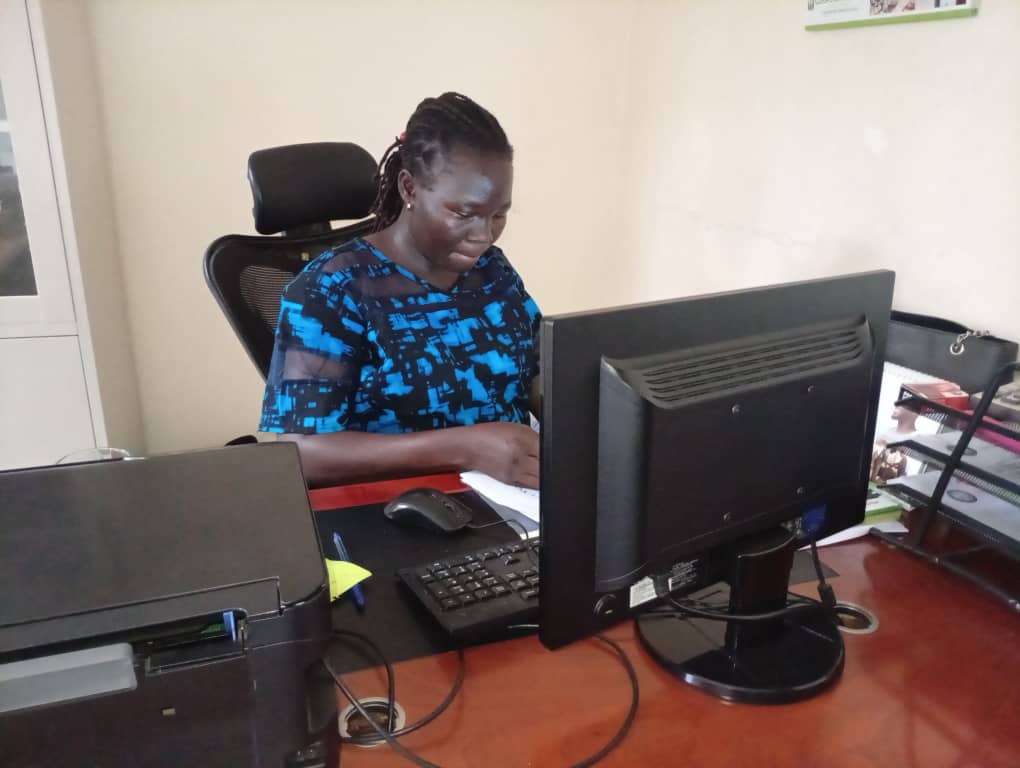
Atimaku Jane, Finance Manager, working at her desk at the PRO Seed Ltd corporate headquarters in Juba
The Seasonal Gap: Spending Upfront, Waiting on the Harvest
In traditional trading or retail, inventory is purchased and sold within short turnarounds. In agriculture, financial planning is defined by extended timeframes and biological schedules. For Atimaku Jane, this extended timeline represents the fundamental reason why agricultural finance is far more complex than outsiders assume.
| “Agriculture is more complex than, let me say, other businesses because when you are doing agriculture, you first spend the money. After spending the money, you then wait for the harvest and sell the product, which takes a long time. When it takes long, it means there is only money going out, but there is no money coming in. That’s why people outside think that agriculture is very complex.” — Atimaku Jane |
Between the initial outlay of capital and the eventual inflow of revenue, an agribusiness must sustain daily operations without breaking liquidity. Capital goes into the soil early in the form of inputs, seed out-grower facilitation, and agronomic support. Yet, months pass before a single cashing event occurs.
| “What happens in PRO Seed when you invest in the farmer’s season is that you have continuous operations. Transport, storage, and processing continue while you are not earning any income from the crop yield. You only begin to earn after you have harvested and sold the product.” — Atimaku Jane |
Managing cash flow across this extended operational gap requires maintaining capital reserves to keep logistical, storage, and processing engines running efficiently while the crop matures.
Navigating South Sudan’s Economic Realities
Operating in South Sudan introduces specific financial challenges, chief among them being macro-economic pressures such as local currency devaluation and inflation. These currency fluctuations directly impact both smallholder farmers and agribusinesses.
| “Generally, in South Sudan, people are facing the issue of local currency devaluation, which is affecting people in the market, especially in PRO Seed. When we engage farmers, we agree to buy the product at a certain amount in SSP, but at the end, there are fluctuations in the market. The price keeps increasing and coming down, and as a result, the farmers may not get a profit, and even PRO Seed does not get a profit from that.” — Atimaku Jane |
To safeguard against inflation and unpredictable price spikes, Jane is advocating for pragmatic, structured mechanisms that stabilize purchasing power across seasons.
| “As a finance person, I am thinking that the farmers and PRO Seed should have a multi-currency system. Multi-currency is where you have both SSP and USD, so the transaction is done in two ways.” — Atimaku Jane |
By anchoring transactions through multi-currency frameworks, PRO Seed aims to protect farmgate income while maintaining predictable procurement costs for its processing units.
Commercial Viability and Knowing When to Step Back
Releasing capital in an agribusiness requires strict criteria. Jane evaluates commercial opportunities by assessing contractual commitments and market demand before approving expenditures.
| “In PRO Seed, when we sign a contract with the targeted buyers and also obtain a high profit margin, we know that a product is wanted in the market. That can also help in supporting the cost.” — Atimaku Jane |
Conversely, financial leadership requires identifying market instability early and holding back capital when risks threaten commercial stability—such as side-selling, where contracted supply chains break down.
| “Yes, in a scenario where you see that the market is unstable, like there are side-selling farmers. In that situation, your market cannot survive and your goods cannot survive in that market, so you have to step back a bit.” — Atimaku Jane |

Financial Discipline as a Growth Engine
Financial discipline is often viewed as a constraint, but at PRO Seed, it serves as the foundation for infrastructure growth and external funding. Daily operational cost management provides the company with emergency buffers and strategic capital.
| “As PRO Seed, we are a seed company. Our operation is daily, but we have to control the costs. Cost management is very important for us. By controlling the costs, in future PRO Seed will have a cost at hand which can be able to help in solving future problems.” — Atimaku Jane |
Furthermore, transparent reporting and rigorous record-keeping build institutional credibility with commercial banks and international development partners.
| “Secondly, we have to have good financial records. That can attract investors and also secure some bank loans.” — Atimaku Jane |
Unlocking Value Across the Maize Value Chain
PRO Seed’s strategy of controlling the complete maize value chain—transitioning from certified seed production into flour milling (Hagana Maize Flour) and livestock feeds (Tamam Animal Feeds)—creates clear commercial synergies.
| “It is a bit interesting because PRO Seed has majorly been in seed, but now we are transitioning into milling of flour. Milling is the conversion of grain to flour, and then from the flour to animal feeds, which can help in generating more profit for PRO Seed. That’s why you release the money for buying the machines.” — Atimaku Jane |
By processing raw grain into consumer goods and converting milling by-products into animal feed, PRO Seed creates multiple revenue streams, maximizing the economic value extracted from every ton harvested.
What Investors See—And What the Numbers Don’t Show
When international partners evaluate an agribusiness, financial statements provide proof of historical performance. However, Jane points out that financial metrics tell only part of the story.
| “That question is complicated. When a partner comes and sees the ambitions of PRO Seed, what they may be interested in is the sales record and also how the company has been managing its finances. That can give them hope that they can manage the business.” — Atimaku Jane |
While clean balance sheets build initial confidence, Jane emphasizes that spreadsheets capture only the financial outcome—completely missing the human grit, agricultural risk, and community relationship building that make those numbers possible in the first place.
| “They do not see the background work, like how the farmers do the field production. That is not what they see. They only see money. In finance, they see the money and they see the records. But of course, they have to go to the farmers and also check how the farmers are doing.” — Atimaku Jane |
Audited ledgers demonstrate management capability, but verifying operational resilience requires observing farm-level production and out-grower trust in the field.
The Three-Way Balance: Farmer, Consumer, and Enterprise
Balancing farmer compensation, consumer affordability, and enterprise margin is executed through structured budget and cost allocations.
| “We ensure that balance through budget allocation and cost allocation. This product costs this amount of money, and the money we budgeted for this product is this amount of money. We also want to buy from the farmers using our budget.” — Atimaku Jane |
Jane illustrates this balance through a practical pricing example:
| “At the same time, when we are selling to consumers, we don’t sell more than what is necessary. If I buy from the farmers at 5,000, I should not be selling to the consumer at 1,500. The profit PRO Seed will get is only 500. This means that in the market we have not cheated the customers, and we have also not cheated the farmers. Meanwhile, PRO Seed has benefited by getting the 500 profit.” — Atimaku Jane |
This pricing structure ensures farmers are compensated fairly, consumers receive access to reasonably priced local staples, and the business retains margin to reinvest.
The Philosophy Behind the Numbers
For Atimaku Jane, PRO Seed’s motto—“If you ate today, thank a farmer”—connects operational service to tangible rewards.
| “Generally, in finance, when you do a good service and you are delivering well, at the end of the month you get your salary. And also in PRO Seed, when you invest in farming, the result will be a good yield. That’s how we say, when you eat today, thank a farmer tomorrow.” — Atimaku Jane |
A Foundation for Sustainable Growth
Atimaku Jane’s approach demonstrates that strategic financial management is essential to agricultural development. By managing seasonal cash gaps, implementing risk buffers, maintaining cost discipline, and allocating margins fairly, financial leadership provides the foundation that allows PRO Seed to transform South Sudanese agriculture from the ground up.